It's weird how all the screenwriting books and magazines and podcasts are the worst kind of procrastination tools for writers. Man, if we're trying to avoid writing there's nothing better.
The irony is they may serve you best when you're actually working on something.
An example: I'm working on a rewrite of a feature and like a good boy I've been trying to avoid buying and reading the latest issues of the usual magazines. Trying to stay away from the usual websites. Keep away from my iPod.
I need to be strict with myself. Why? Things like: I once took a whole week off work because I convinced myself I had to watch the first three seasons of Buffy-- all at once. I mean, it made my dialogue very Weldonesque for a while but really.
The thing is when I'm actually working on something-- maybe that's the best time to be getting ideas from other writers. Today I had to take a longish drive out of town so I decided to take my iPod and listen to an old Creative Screenwriting Podcast with James Mangold talking about I Walk The Line.
Mangold was sharing a story about the trouble with shooting the musical numbers-- about needing to have a problem in every musical number. To make it not just be about the music. To have drama in the scene.
Insert awakening metaphor here.
It was just the reminder I needed. I find sometimes I wraps things up too early. I resolve problems between characters too soon. Maybe it's because I'm a middle child and have a natural tendency to play the peacemaker... But having the couple make up, or the bully get his comeuppance, or Indy find the Ark of the Convenant, before they absolutely have to is a mistake.
The reason the story goes on is because something isn't right, or unresolved, or broke. And once it's fixed whether you have 2 pages left or twenty-- your story is done.
So resist your natural and wholesome urge to fix things. Indulge your unnatural and evil urge to prolong the suffering of your characters until the last possible moment.
And save all those magazines, books and podcasts until you're actually working on something.
Saturday, August 12, 2006


Friday, August 11, 2006

Wednesday, August 09, 2006
The God Who May Be

I don't know how many of you are radio fans, and of you radio fans, how many are CBC fans, and of you CBC fans how many are Ideas fans, and of you Ideas fan how many of you heard the third part of the program "The God Who May Be" last night. But it was very interesting. I can't encapsule all the issues touched on but here's the blurb from the CBC website:
It was a modern axiom that philosophy and religion should be strangers, the one relying on reason the other on revelation. But, as the limits of both reason and revelation have become clearer, a new conversation has begun, and Irish philosopher Richard Kearney has been one of its leaders. In a three-part conversation with David Cayley, he talks about his philosophy of the imagination and his book, The God Who May Be.
Of particular interest to writers was Kearney's journey from the roots of Irish literature to reality television to the monsters of imagination in Post 9/11 world culture. Some of which came, I believe, from another of his book: Strangers, Gods and Monsters
I can only hope that the program eventually comes up on the Ideas podcast... if not I'll just have to get the books.
Monday, August 07, 2006
Overheard in Charlottetown
How come nobody ever told me about this awesome blog? The thing I like best: it delivers what it promises. A bunch of expressions, snatches of conversations, bits of dialogue overheard. But, to be fair, there's some from out of town too.
Sunday, August 06, 2006
Dave's Yes/No Movie Review: The Descent.

Yes. If you've already seen the film, I recommend reading Jim Emerson's thoughtful review as well as his thoughts on non-cinematic inspiration for and from the film.
Sci-fi Fans... stay tuned.
Great Idea. From the Futon Critic, comes news of a new "Masters of..." series. First there was a "Masters of Horror" shot in Vancouver. Now, from the same producers, I believe, a "Masters of Science Fiction" series is in the works. From the site:
Among the other "masters": works by or based on the venerable Harlan Ellison, and Robert Heinlein.
Acclaimed physicist Professor Stephen Hawking will introduce each episode. Award-winning director Mark Rydell (On Golden Pond, The River, The Rose) and writer/director Michael Tolkin (The Player, The Rapture, The Burning Season) directed the first two episodes. Directors for the subsequent four episodes include Harold Becker (Sea of Love, Malice, Mercury Rising), Darnell Martin (Their Eyes Were Watching God, I Like It Like That), Michael Petroni (Til Human Voices Wake Us, Dangerous Lives of Altar Boys) and Jonathan Frakes (Star Trek: Insurrection, Star Trek: Voyager, Roswell).
Among the other "masters": works by or based on the venerable Harlan Ellison, and Robert Heinlein.
Friday, August 04, 2006
Great Transitions Part II
In Great Transitions Part I was yakking about what I thought were great story turns that were held within a Cut. In the interest of expanding the idea of what a Transition is, or might be, thought I'd mention what I believe to be a couple of great story transition... but these turns are held within a character.
The best place to look for them in film is around the end of the "second act" where a characters world is turned figuratively or literally upside down.

The first one that popped in my head was the famous "my daughter... my sister" scene from Chinatown. Jake, our hero, reacts with violence at what his brain just cannot comprehend. Evelyn asks if he can understand..."or that just too much for you." It is.

The second scene that came to mind was a scene from another Kubrick film: The Shining. Nope. Not the "Here's Johnny" scene. But the scene just before it. Shelley Duvall comes into the room where her husband Jack has been spending months isolated from the world "working on his novel." When she trespasses into his work space she leaves behind any hopes she might have held, or delusions she might still be clinging on to. She reads the words of her husband's book and her life is destroyed forever.
These moments don't have to be filled with terror though. There's a great moment of transition for Scout and Jem in To Kill a Mockingbird.

For the first half of the film they are convinced that Atticus, their father, is about the most boring man in town. Then the day comes when a rabid dog comes into the neighbourhood and the Sheriff calls for Atticus to come from his law offices to shoot it. Atticus aims, takes off his glasses and throws them to the ground and brings the sick animal down in one shot.
His children are amazed. They didn't realize their soft spoken father was "the best shot in the county." Their world isn't what they thought it was.
It's a great scene that foreshadows the climax of the film, when Boo Radley comes to save Scout and Jem from a mad dog of an entirely different sort.
What about you... Any great character transition from films that haunt you?
The best place to look for them in film is around the end of the "second act" where a characters world is turned figuratively or literally upside down.

The first one that popped in my head was the famous "my daughter... my sister" scene from Chinatown. Jake, our hero, reacts with violence at what his brain just cannot comprehend. Evelyn asks if he can understand..."or that just too much for you." It is.

The second scene that came to mind was a scene from another Kubrick film: The Shining. Nope. Not the "Here's Johnny" scene. But the scene just before it. Shelley Duvall comes into the room where her husband Jack has been spending months isolated from the world "working on his novel." When she trespasses into his work space she leaves behind any hopes she might have held, or delusions she might still be clinging on to. She reads the words of her husband's book and her life is destroyed forever.
These moments don't have to be filled with terror though. There's a great moment of transition for Scout and Jem in To Kill a Mockingbird.

For the first half of the film they are convinced that Atticus, their father, is about the most boring man in town. Then the day comes when a rabid dog comes into the neighbourhood and the Sheriff calls for Atticus to come from his law offices to shoot it. Atticus aims, takes off his glasses and throws them to the ground and brings the sick animal down in one shot.
His children are amazed. They didn't realize their soft spoken father was "the best shot in the county." Their world isn't what they thought it was.
It's a great scene that foreshadows the climax of the film, when Boo Radley comes to save Scout and Jem from a mad dog of an entirely different sort.
What about you... Any great character transition from films that haunt you?
Wednesday, August 02, 2006
And it reads so much sexier!
In backtracking some of the visitors to Don't Feed the Writer. I discovered my entire blog-- translated into french!
Pour service en français, clickez.
Pour service en français, clickez.
Tuesday, August 01, 2006

Monday, July 31, 2006

BSG Season Three Update
I don't know how many among you are BattleStar Galactica fans, I only know you all should be!
BSG re-imaginer Ronald D. Moore (writer: Star Trek TNG, and creator: Carnivale) has updated his series blog, with many hints about the upcoming season.
A PEI connection: Our very own Lauren Walker is rumoured to be working in the costume department.
And with one post Dwight Schrute brings all my favorite worlds together.
BSG re-imaginer Ronald D. Moore (writer: Star Trek TNG, and creator: Carnivale) has updated his series blog, with many hints about the upcoming season.
A PEI connection: Our very own Lauren Walker is rumoured to be working in the costume department.
And with one post Dwight Schrute brings all my favorite worlds together.
Saturday, July 29, 2006
Taste of Fall

Summer's not over yet, but the taste of fall is in the air. And from where I'm sittin' the cool fall will be a welcome change from the muggy summer. I'm talkin' movie shows. It looks like this fall is shaping up very nicely so far with at least two must see film. James Ellroy's Black Dahlia directed by Brian DePalma (I know, I know, but the trailer is looking more like The Untouchables DePalma and not Raising Cain DePalma) and the remake of the Hong Kong film Infernal Affairs, entitled The Departed. It's directed by Martin Scorcese with a huge cast. And because we're all hot about the writers on this blog it's interesting to note that Black Dahlia was written by Josh Friedman whose blog, though only updated sporatically is definitely worth checking out. The Departed is written by Kingdom of Heaven scribe, William Monahan.
Friday, July 28, 2006

Thursday, July 27, 2006
Great Transitions Part I
A recent comment by Hamish reminded me of a conversation we had had when he was visiting the Island a couple of weeks ago. I was mentioning something I heard Stephen Gaghan attribute to the russian novelist Leo Tolstoy.
I'm para-phrasing here, but Gaghan, while he was being interviewed for the Creative Screenwriting Podcast about his film Syriana, said Tolstoy listed the four most important elements for writing a novel: 1. Transitions 2. Context 3. Character and last (and, in the self-styled-anti-mckee-Gaghan's opinion, least) 4. Story.
There's a whole post and a half waiting about that list but I thought instead we could talk about Great Transitions. I'm not sure that this is what Gaghan (or Tolstoy) was talking about but for the purposes of this post I'll keep my comments to what I think are some Great Transitions in Film.
The two kinds of Transitions I was thinking of were: 1. Great edits. Where the cut of the film took us from one world into another. 2. Great Transitions of Story/Character, moments of a film where the characters world turns upside down... sometimes literally.
For today I just want to mention a couple of my favorite edits.
In the first category, my two suggestions might be a little Film School 101 but I remember being blown away by two cuts the first from Lean's Lawerence of Arabia.
Lawrence puts out a match with his fingers. Then shows another soldier how he does it. The soldier is burned:
And soon after comes the great moment where the flame of the struck match is blown out into the burning desert sun. It's a powerful cut that literally drags us through time and space, and introduces the central motif of the flame of a man's spirit and life tied to the burning desert sun, a man who will literally light the fuse of an entire culture.
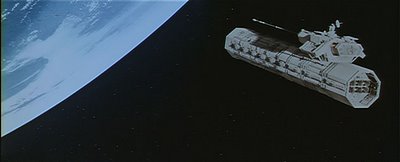
The second Great Transition is from Stanley Kubrick. The jump of thousands of years with the toss of a bone in 2001: A Space Odyssey.
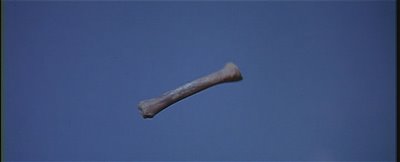
The cut from bone to space station introduces the idea of how closely the evolution of our species is tied to the evolution of our technology and sets up the journey of where there evolution maybe leading us.
I'll post in a couple of days about some thoughts from the second category of Great Transitions.
If you'd like to email me some suggestions with or without links to an appropriate pic I'd be happy to post it. Contact info is just on the side thingy there.
I'm para-phrasing here, but Gaghan, while he was being interviewed for the Creative Screenwriting Podcast about his film Syriana, said Tolstoy listed the four most important elements for writing a novel: 1. Transitions 2. Context 3. Character and last (and, in the self-styled-anti-mckee-Gaghan's opinion, least) 4. Story.
There's a whole post and a half waiting about that list but I thought instead we could talk about Great Transitions. I'm not sure that this is what Gaghan (or Tolstoy) was talking about but for the purposes of this post I'll keep my comments to what I think are some Great Transitions in Film.
The two kinds of Transitions I was thinking of were: 1. Great edits. Where the cut of the film took us from one world into another. 2. Great Transitions of Story/Character, moments of a film where the characters world turns upside down... sometimes literally.
For today I just want to mention a couple of my favorite edits.
In the first category, my two suggestions might be a little Film School 101 but I remember being blown away by two cuts the first from Lean's Lawerence of Arabia.
Lawrence puts out a match with his fingers. Then shows another soldier how he does it. The soldier is burned:
William Potter: Ooh! It damn well 'urts!
T.E. Lawrence: Certainly it hurts.
Officer: What's the trick then?
T.E. Lawrence: The trick, William Potter, is not minding that it hurts.
And soon after comes the great moment where the flame of the struck match is blown out into the burning desert sun. It's a powerful cut that literally drags us through time and space, and introduces the central motif of the flame of a man's spirit and life tied to the burning desert sun, a man who will literally light the fuse of an entire culture.
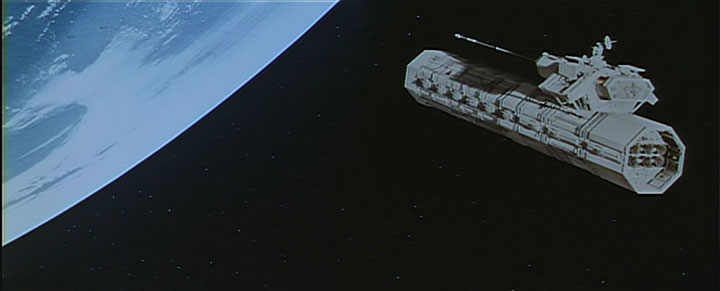
The second Great Transition is from Stanley Kubrick. The jump of thousands of years with the toss of a bone in 2001: A Space Odyssey.
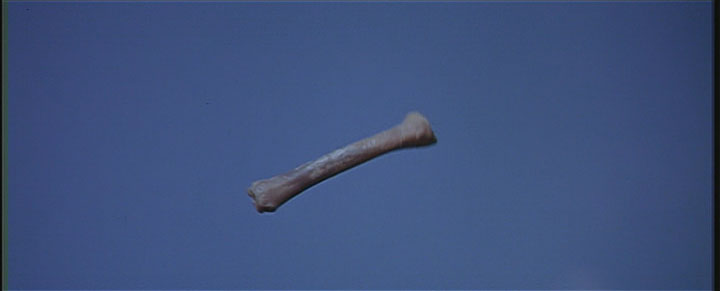
The cut from bone to space station introduces the idea of how closely the evolution of our species is tied to the evolution of our technology and sets up the journey of where there evolution maybe leading us.
I'll post in a couple of days about some thoughts from the second category of Great Transitions.
If you'd like to email me some suggestions with or without links to an appropriate pic I'd be happy to post it. Contact info is just on the side thingy there.
Monday, July 24, 2006
Lady in the Water: Story must be attacked

I was having a great chat with my buddy Jason at work this morning. We were comparing notes on the new M. Night Shyamalan movie, Lady in the Water. He despised it with a passion that surprised me, while I who had his expectations systematically lowered by advanced word of mouth didn't.
I mean, there was great badness, but not much greater badness of story writing than I endured through Superman Returns, X-men III, and PoCII.
I think I can help though.
Seriously.
I think I see what Shyamalan's problem is: it's the central premise of his film. "Story must be protected!" But anyone who has done any writing at all knows: Story must be attacked.
Spoilers ahead.
Forget the missed opportunities of Lady in the Water, the film that could have been where characters discover that they are in a bedtime story and what that means to be a slave of narrative... and what kind of Pirendello adventure that might have been.
As is, the Lady, named Story, comes looking for a Writer. Story is a fragile thing... naked and vunerable, barely a whisp. If Story can find the Writer, the Writer can be Inspired, and through Story, share some Deep Knowledge that can Change the World.

As subtle as a brick to the nose but that's okay. It sets up the stakes, gives our characters some needs. All I'm saying is that there are worse places to start.
The trouble is M. Night does stay true to his metaphor. The film is all about our heroes trying to protect Story from the Wolves long enough that she can get her job done. But writing isn't about protecting fragile story. I mean, that could be an interesting beginning. Seeing Story under seige by all these apparently malevolent forces. And the first reaction is a defensive one. Protect the story... then it would have been interesting, and more truthful I think, to have the people realize the truth.
For Story to survive it must be attacked. Loved and nutured too, for sure, especially in its early stages, but to last? To live? The writer will have to turn on his Story.
The Writer isn't some Warrior Eunch assigned by fate to protect Story's virtue. The Writer must seduce the story, get to know it better than anyone else could. And then... please forgive the x-rated analogy but as far as Story goes, the Writer's gotta fill every hole. And please forgive me again as I say: the Writer services Story best when his love is hard.
The lesson of the Script-doctor--uhm... I mean, Healer-- isn't some atonement for letting down some old story in the past. The lesson for the Healer is that there is only one terrible thing you can do to protect Story. And that is to give her to the wolves and allow her to be torn apart.
To watch as her every fault and weakness, however beautiful, ethereal or pure is consumed and destroyed. Leaving only Story's heart untouched.

And when the Writer puts her back together again she may be changed, but she will be better, stronger, and more beautiful.
That's the Story that I'd tell anyway.
Sunday, July 23, 2006
Speaking of context...
If you haven't caught the link to the Vader Sessions, check it out. It's an hilarious mashup of Darth Vader and the voice of James Earl Jones. The editors have used dialogue from movies throughout his career to... give a new spin to some old scenes, baby. It's worth it to stick around for the "dial spinning" near the end.
Thursday, July 20, 2006

Wednesday, July 19, 2006
Emotion Delivery Engineer: Part One
The more I read, the more I watch, the more I write, the more I understand that storytelling, in any genre, is about the delivery of emotions. When you pick up a book or go to a movie, see a play, listen to your grandma, you are doing so with the expectation of feeling something. You want an emotional ride.
You ask the storyteller to throw you into misery to make you laugh, into confusion help you make sense, into terror to let you feel relief, into the lives of the alienated so that you might feel connected. If these expectations aren't fulfilled you feel unsatisfied. Comedy's gotta make you laugh and horror's gotta make you feel scared or you feel cheated.
For writers and performers it can make for difficult times especially when you decide to bend or blend genres, or shift tone within a piece.
The first time I remember this happening to me was while I was a teenager watching Jimmy Stewart in No Time for Comedy on some CBC afternoon movie or something. The first half of the movie played like a Frank Kapra comedy, fun and quirky... then at the halfway point of the movie, it became a drama. And it kinda makes sense the screenwriter was one of the writers on Casablanca... and Arsenic and Old Lace. Two great films... one weird mash up.
The experience was interesting... but I wouldn't call it enjoyable.
I find I'm learning a lot about craft by looking at the reasons I look forward to or enjoy particular books or movies. Why do I keep going back to the same writers, the same directors, the same books, the same movies again and again.
I suggest we're looking for the creation or repetition of a feeling... a satisfying emotional experience. I think this is why certain authors and filmmakers become brands. You know what you're going to get if you pick up a Charles Dickens, Margaret Atwood, Bernard Cornwell, Nick Hornby; see a film by Kapra, Kurasawa or the Coen brothers; just as sure as you know what you're going to get if you watch The Simpsons, Deadwood, Frasier, or Felicity (okay, I don't know about Felicity but I bet the people that liked it... liked it.)
I'm saying there's something more than style. There's a feeling you want to have when you experience a story that has nothing to do with special effects or movie stars but has to do with fulfilling the emotional need of the audience.
The writer's job is, through story, to deliver it.
You ask the storyteller to throw you into misery to make you laugh, into confusion help you make sense, into terror to let you feel relief, into the lives of the alienated so that you might feel connected. If these expectations aren't fulfilled you feel unsatisfied. Comedy's gotta make you laugh and horror's gotta make you feel scared or you feel cheated.
For writers and performers it can make for difficult times especially when you decide to bend or blend genres, or shift tone within a piece.
The first time I remember this happening to me was while I was a teenager watching Jimmy Stewart in No Time for Comedy on some CBC afternoon movie or something. The first half of the movie played like a Frank Kapra comedy, fun and quirky... then at the halfway point of the movie, it became a drama. And it kinda makes sense the screenwriter was one of the writers on Casablanca... and Arsenic and Old Lace. Two great films... one weird mash up.
The experience was interesting... but I wouldn't call it enjoyable.
I find I'm learning a lot about craft by looking at the reasons I look forward to or enjoy particular books or movies. Why do I keep going back to the same writers, the same directors, the same books, the same movies again and again.
I suggest we're looking for the creation or repetition of a feeling... a satisfying emotional experience. I think this is why certain authors and filmmakers become brands. You know what you're going to get if you pick up a Charles Dickens, Margaret Atwood, Bernard Cornwell, Nick Hornby; see a film by Kapra, Kurasawa or the Coen brothers; just as sure as you know what you're going to get if you watch The Simpsons, Deadwood, Frasier, or Felicity (okay, I don't know about Felicity but I bet the people that liked it... liked it.)
I'm saying there's something more than style. There's a feeling you want to have when you experience a story that has nothing to do with special effects or movie stars but has to do with fulfilling the emotional need of the audience.
The writer's job is, through story, to deliver it.
Why I'm glad the world isn't HBO (revised)
I was out for my evening walk (that I say is for fresh air but is really to avoid writing work) last night. When I stumbled upon several of the boys from Sketch22 sitting down and having a beer. Sketch22, for those who may not know is a sketch comedy group... a troupe... gang... here in Charlottetown. They are enjoying their third summer of fairly large and often sold out houses, but aren't without controversy. It doesn't seem to bother most of them.
Anyway, after they were gracious enough to invite me to join them, conversation turned to the shows everybody's been watching and in particular HBO's very fine Deadwood. Now not everybody had seen it, some had been meaning to watch it, some had only watched season one, some season two, and a couple of us have been enjoying season three, but we all agreed what a fine show it was and what a shame that HBO wasn't going to let them do a fourth season. But that HBO had a lot of fine programming.
This led to one of the guys to say: "Man, their shows are so awesome. They can say anything they want, they can show anything they want! I wish the world was HBO!"
And for some reason this got me all squawky. I started talking about how that's crazy talk and I don't want HBO programming all over. That I wanted HBO to stay on HBO, and many other things I just didn't believe.
It took me a day of rolling my eyes at myself, and working on another post about "branding" and story-telling (coming soon) to figure out what set me off.
It seemed to me that HBO was somehow being equated with freedom of artistic expression. Instead of a brand that stands for a particular kind of programming. Which led me to wonder: is showing sex and violence and using strong language freedom of expression when you HAVE to show sex and voilence and use strong language?
I would argue: It's not freedom, it's HBO.
Anyway, after they were gracious enough to invite me to join them, conversation turned to the shows everybody's been watching and in particular HBO's very fine Deadwood. Now not everybody had seen it, some had been meaning to watch it, some had only watched season one, some season two, and a couple of us have been enjoying season three, but we all agreed what a fine show it was and what a shame that HBO wasn't going to let them do a fourth season. But that HBO had a lot of fine programming.
This led to one of the guys to say: "Man, their shows are so awesome. They can say anything they want, they can show anything they want! I wish the world was HBO!"
And for some reason this got me all squawky. I started talking about how that's crazy talk and I don't want HBO programming all over. That I wanted HBO to stay on HBO, and many other things I just didn't believe.
It took me a day of rolling my eyes at myself, and working on another post about "branding" and story-telling (coming soon) to figure out what set me off.
It seemed to me that HBO was somehow being equated with freedom of artistic expression. Instead of a brand that stands for a particular kind of programming. Which led me to wonder: is showing sex and violence and using strong language freedom of expression when you HAVE to show sex and voilence and use strong language?
I would argue: It's not freedom, it's HBO.
Sunday, July 16, 2006
Trailer for the new Michel Gondry film.
Can't wait! It's got the homemade quality of so much of his work: dream sequences like his Chemical Brothers video, the Giant Hands of his Everlong video, the helpless romance of Eternal Sunshine... plus the sexy french accents. Boni Plus!
Subscribe to:
Posts (Atom)